Restorative Dentistry
Restorative dentistry is the work of repairing and replacing teeth that are damaged, worn, or missing — fillings, inlays and onlays, crowns, bridges, implants, dentures, and root canal therapy. This page is a map of the options and how they fit together, at our Vienna office minutes from Tysons Corner.
Start with the tooth you still have
Restorative dentistry is the work of repairing and replacing teeth that are damaged, worn, or missing. It covers fillings, inlays and onlays, crowns, bridges, implants, dentures, root canal therapy, and veneers, and the reason it is worth understanding as a whole rather than one treatment at a time is that the options sit on a ladder.
Tooth enamel is the hardest substance in the body, harder even than bone. It is also not replaced once it is gone. Every restoration is therefore a substitution, and a good plan uses the smallest substitution that will actually hold. That principle decides most of what follows on this page.
The practical version: catch a problem early and the answer is small; leave it and the answer gets larger. A cavity found at a checkup is a filling. The same cavity in two years may be an onlay, a crown, or root canal therapy. None of those are catastrophes, but the first is a great deal easier than the third.

The ladder, from least to most
Roughly in order of how much of the tooth is involved. Where two options would both work, the more conservative one is generally the better choice.
Fillings
For decay caught while most of the tooth is still sound. Tooth-colored composite is shade-matched, mercury-free, bonded to the tooth, and conservative with what is left around it.
Inlays and onlays
For a chewing surface too damaged for a filling to hold reliably. Made in a laboratory and cemented in as one piece, and less destructive than a crown where the walls of the tooth are still sound.
Crowns
For a tooth that is cracked, heavily worn, or too broken down to be repaired from the inside. A crown covers the whole tooth and holds it together. Ours are made by Oral Prosthetics Lab in e.max or BruxZir Zirconia.
Root canal therapy
For infection inside the tooth. It treats the cause and keeps the tooth, and it is almost always followed by a crown, because a root-treated tooth is more brittle than it was.
Veneers
Thin custom shells bonded to the front of a tooth. Chiefly cosmetic, but genuinely restorative where front teeth are chipped or worn as well as discolored.
Replacing a tooth entirely
Where a tooth cannot be kept, an extraction is followed by a plan to fill the space: an implant, a bridge, or a denture. That decision is worth taking properly.
Replacing a missing tooth: three routes
These three come up together constantly, and they are genuinely different propositions rather than three versions of the same thing. None is best in the abstract.

Implants
Replace the root as well as the tooth, so bone mass under the gap is preserved and the neighboring teeth are left untouched. It involves surgery and a healing period measured in months, and it depends on there being enough bone. Dr. Lokitis trained in implant surgery during her hospital residency.
Bridges
Fixed, generally quicker, and no surgery. The trade is that the teeth on either side are prepared for crowns to anchor it, which makes good sense when those teeth need crowns anyway and less sense when they are perfectly healthy.
Dentures
Full or partial, removable, and the least invasive route. They suit several missing teeth, a staged plan, or a case where surgery is not appropriate. Implant-supported dentures sit between the two, clipping onto posts in the jaw.
How a plan gets made
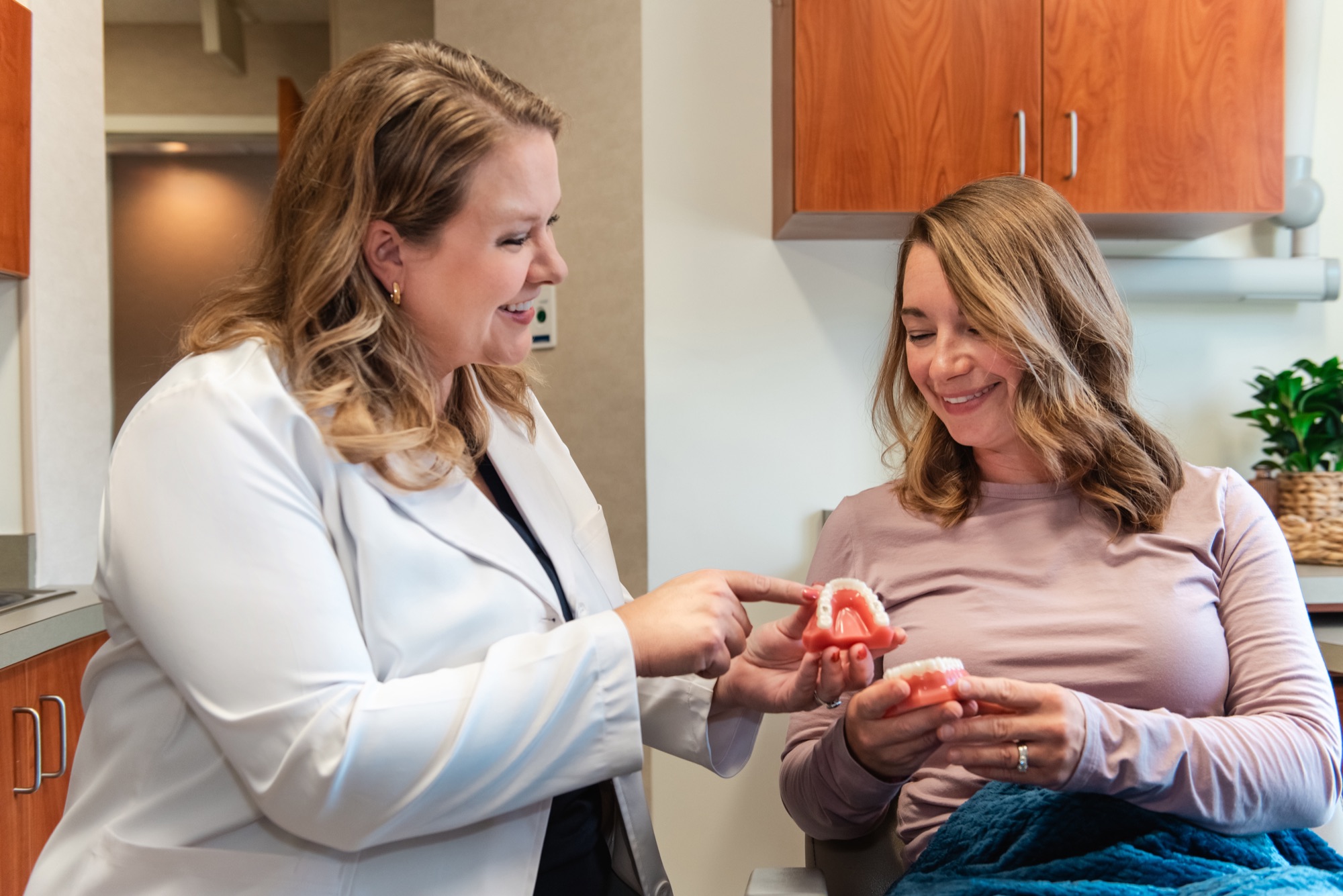
A restorative plan starts with a full picture rather than the tooth that is currently complaining. That means an exam, digital X-rays, a tooth-by-tooth cavity and restoration assessment, a look at the gums, and a 3D intraoral scan you can see on the screen beside you.
The scan matters more than it sounds. It is a good deal easier to make a decision about a tooth you have actually looked at than about one described to you, and it puts you and Dr. Lokitis on the same side of the conversation. The iTero health scan is offered to every patient here at no charge.
From there the work is sequenced. Urgent things first, then structural work, then anything cosmetic, and the whole thing paced to suit you. We explain procedures thoroughly and build treatment plans that suit your individual needs, with no upselling and no overtreatment. You will never feel rushed or pressured here.
When several teeth need attention
If it has been a while since your last visit, the list can look long written down. It very rarely has to be done at once. Anything painful or actively infected comes first, then teeth at risk of fracture, then work that can reasonably wait, and cosmetic changes last of all. A plan spread over months is a normal plan, not a compromise.
Two things are worth folding in while the sequence is being set. The first is your bite: if teeth are wearing unevenly, or your jaw aches or clicks, restoring individual teeth without looking at why they are wearing tends to store the problem up. Read teeth grinding and TMJ treatment alongside this page. The second is gum health, since no restoration outlasts the foundation it sits on. See periodontal disease.
And once the work is done, keeping it is mostly unglamorous: brushing, flossing the margins where restorations meet teeth, regular cleanings and exams, and a night guard if you grind. Restorations do not decay, but the natural tooth at the edge of them can, and that is where the work is most often lost.
Dr. Julia Lokitis earned her DDS from the University of Maryland, Baltimore with special honors in prosthodontics, the discipline concerned with restoring and replacing teeth, and completed a one-year general practice residency at York Hospital in Pennsylvania with advanced training in restorative work, oral surgery, implant surgery, and dental trauma management. She has spent over 15 years in general practice. Our office is on Old Courthouse Road in Vienna, a few minutes from Tysons Corner and convenient to McLean, Dunn Loring, Merrifield, Oakton, Great Falls, and Falls Church.
Frequently Asked Questions
What counts as restorative dentistry? expand_more
Anything that repairs or replaces tooth structure: fillings, inlays and onlays, crowns, bridges, implants, dentures, and root canal therapy, with veneers sitting on the border between restorative and cosmetic. The common thread is that enamel does not grow back, so the work is always a substitution for something lost.
How do you decide between a filling, an onlay, and a crown? expand_more
By how much sound tooth is left and how heavily that tooth is loaded. A filling relies on the tooth around it to hold it, so it suits a cavity in an otherwise solid tooth. An onlay replaces a damaged chewing surface as one laboratory-made piece. A crown covers the whole tooth and is for teeth that are cracked, worn, or too broken down to be repaired from the inside.
Do I have to do everything at once? expand_more
Almost never. Urgent and painful things come first, then teeth at risk of fracture, then work that can reasonably wait, then anything cosmetic. Spreading a plan over months is normal. Tell us what is realistic for you and the sequence will be built around that rather than presented as all or nothing.
Can a badly damaged tooth still be saved? expand_more
Often, yes. A tooth with deep decay may need root canal therapy and a crown but can stay in service for years afterwards. What generally cannot be saved is a tooth with a fracture running into the root, or one where decay has gone below the level of the bone. Where that is the case Dr. Lokitis will say so plainly rather than attempting work that cannot hold.
What if I have not seen a dentist in years? expand_more
You would be in more company than you think, and there is no lecture waiting. The first visit is an exam, X-rays, a scan and a conversation, and the outcome is a written sense of where things stand and what order to tackle it in. You will never feel rushed or pressured here, and nothing has to be decided on the day.
Will insurance cover restorative work? expand_more
Most plans contribute to restorative treatment, though what they cover and to what extent varies a great deal, and many carry an annual maximum that affects how a larger plan is best sequenced. We are happy to check your benefits and go over what treatment involves before anything begins.
How long does restorative work last? expand_more
It depends on the restoration, the tooth, and the bite, and the single biggest variable is how well the margins where restorations meet teeth are kept clean. Grinding shortens the life of almost everything, which is why a night guard comes up so often. Regular cleanings and exams catch problems at the stage where they are still small.
One exam, one plan, in an order that suits you.
A restorative consultation is an exam, digital X-rays, a 3D scan you can see for yourself, and a plan that starts with what matters most. Contact our Vienna office, minutes from Tysons Corner.