TMJ Treatment
TMJ (temporomandibular joint) disorder involves dysfunction of your primary jaw joint. Symptoms include popping, clicking, or locking of the jaw, headaches, muscle pain, and abnormal tooth wear. Please don't suffer needlessly in silence.
The joint you use more than any other
You have a temporomandibular joint on each side of your head, just in front of the ear, where the lower jaw meets the skull. It is an unusual joint: it hinges like a door and slides forward at the same time, and the two sides have to work together. You use it every time you speak, eat, swallow, or yawn — thousands of times a day, without ever thinking about it.
When something in that system is off — the joint itself, the cushioning disc inside it, or the muscles that drive it — the result is what clinicians call a temporomandibular disorder, or TMD. Most people say “TMJ,” and we know what you mean either way. It is common, it is rarely dangerous, and it very often responds to conservative treatment.
What makes TMJ frustrating is that it does not always announce itself as a jaw problem. People arrive having been told their headaches are migraines, or that the ache behind their eyes is sinus, or that the ringing in their ears is unexplained. The jaw is often the last place anyone looks.

Symptoms worth mentioning to us
You do not need all of these, and you do not need to be in severe pain to raise it. If a few of them sound familiar, mention it at your next visit.
What tends to be behind it
TMJ rarely has one clean cause. More often it is two or three things overlapping, which is why treating only the loudest symptom tends to disappoint. These are the threads we look for.
Clenching and grinding
The most common companion to TMJ. Hours of sustained pressure on the joint and the muscles around it will make almost any jaw sore. Much of it happens at night, which is why people are often surprised to learn they do it at all. More on teeth grinding and bruxism.
How your teeth meet
If your bite is uneven, your jaw muscles compensate to find a comfortable resting position, and they do it all day. Missing teeth, a crown that sits slightly high, or long-standing crowding can all contribute.
Stress, posture, and habit
Jaw tension is one of the body's quieter stress responses. Long hours at a desk, phone cradled on a shoulder, or a jaw held tight through a hard week all add up in the same muscles.
Injury and joint wear
A blow to the jaw, a whiplash injury, or arthritic change in the joint can all disturb how it tracks. Sometimes the original event was years ago and had been forgotten.
Disrupted breathing at night
Grinding and airway problems frequently travel together. If you snore, wake unrefreshed, or have morning headaches alongside jaw pain, it is worth talking about sleep apnea in the same conversation rather than treating the jaw in isolation.
How we work out what's going on
An occlusal exam — a bite evaluation and a check of the joints themselves — is part of a comprehensive exam here, so a good deal of this happens at an ordinary visit. When jaw pain is the reason you came, we go further.
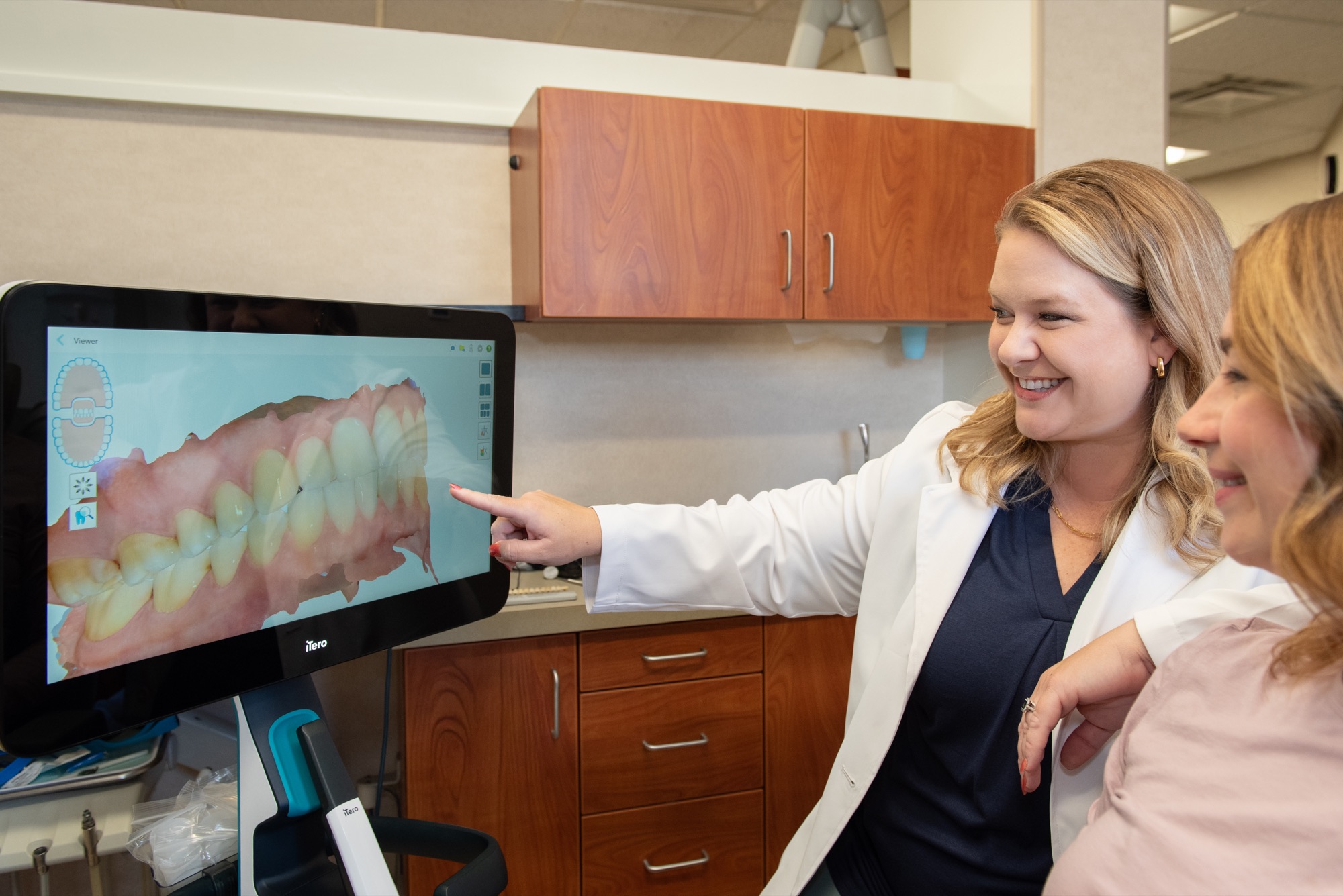
Dr. Lokitis earned her DDS from the University of Maryland, Baltimore with special honors in prosthodontics — the discipline concerned with how bites fit together and function — and has spent over 15 years in general practice. That background is a large part of why bite-related complaints get a careful hearing here.
How TMJ is treated
Dr. Lokitis uses non-surgical methods to address TMJ, including bite splint therapy, orthodontic correction, and therapeutic Botox. Treatment is customized to your specific symptoms and underlying cause. We start with the most conservative option that has a real chance of helping, and we change course based on how you respond rather than on a fixed protocol.
Bite splint therapy
A custom splint is made from impressions of your own teeth and worn while you sleep. It gives the muscles a stable surface to close against and keeps the upper and lower teeth from grinding into one another. For many people this is the first and only step they need.
Orthodontic correction
Where the bite itself is the problem, moving teeth into a better relationship addresses the cause rather than managing the symptom. Invisalign treats crowding, gaps, overbite, underbite, and crossbite, and Dr. Lokitis is a member of the American Academy of Clear Aligners.
Therapeutic Botox
Small, targeted injections relax the muscles that do the clenching, which may ease jaw tension, headaches, and facial pain while the underlying cause is addressed. Dr. Lokitis trained in this through the International Academy of Facial Aesthetics. Read more about therapeutic Botox.
Restoring what the grinding has damaged
Years of heavy force leave flattened, chipped, or cracked teeth behind. Once the forces are under control, crowns, bonding, or other restorative work can rebuild what was lost — in that order, so the new work is not asked to survive the same thing that broke the old.
Referral, when that's the right answer
Physical therapy and massage help a good number of people with muscular jaw pain, and we will say so when we think that is the better next step. We would rather point you somewhere useful than keep treatment in-house for its own sake.
One practical note: treatment for TMJ disorders is sometimes handled by medical insurance rather than dental, and the two work differently. We are glad to check your benefits before you commit to anything.

What a first visit looks like
Unhurried
You will never feel rushed or pressured here. Jaw pain has a history, and the history is usually the most useful thing you bring with you.
Comfortable
Our comfort menu is available at any appointment. Holding your mouth open is the last thing a sore jaw wants, and we work around that.
Explained
We explain procedures thoroughly and build plans that suit your needs — no upselling, no overtreatment. You'll know the cost before anything starts.
Frequently Asked Questions
What is TMJ, and what is TMD? expand_more
TMJ stands for the temporomandibular joint — the hinge on each side of your head that connects your lower jaw to your skull. TMD, or temporomandibular disorder, is the name for problems with that joint and the muscles around it. In everyday conversation people usually say “TMJ” for both, and we know what you mean either way.
Do I need surgery for TMJ? expand_more
Most people do not. Dr. Lokitis treats TMJ with non-surgical methods — bite splint therapy, orthodontic correction, and therapeutic Botox — chosen for your particular symptoms and their likely cause. Surgery is a last resort and is not something we start with.
Is jaw clicking always a problem? expand_more
Not necessarily. A joint that clicks but doesn't hurt, lock, or limit how far you can open is often something to keep an eye on rather than treat. Clicking that comes with pain, catching, locking, or a change in how your teeth meet is worth having looked at.
How is TMJ diagnosed? expand_more
It starts with a conversation and an occlusal exam — how your teeth meet, how far and how evenly your jaw opens, whether the joints are tender, and what your wear patterns and X-rays show. That picture, plus what you tell us about your headaches, sleep, and stress, is what a treatment plan is built on.
Can a night guard from the drugstore help? expand_more
An over-the-counter guard may protect enamel to some degree, but it is not shaped to your bite, and a poorly fitting appliance can change how your jaw closes and leave you more uncomfortable than before. A splint made from impressions of your own teeth is designed for the way your jaw actually moves.
Is TMJ treatment covered by dental insurance? expand_more
It varies. Treatment for TMJ disorders is sometimes handled by medical insurance rather than dental, and the two work differently. We're happy to check your benefits before you commit to anything, and we'll go over what treatment costs with you before we begin.
How long does it take to feel better? expand_more
It depends on what's driving the problem and how long it has been going on. Some people notice a difference within a few weeks of wearing a splint; muscle pain that has built up over years can take longer to settle. We'd rather tell you that honestly than promise a timeline we can't hold to.
Related Services
Please don't suffer needlessly in silence.
Jaw pain is common enough that many people assume it is simply something they live with. Often it is not. Contact our Vienna office — minutes from Tysons Corner — and we will examine it properly.