Periodontal Care
Healthy gums do not bleed when you brush them. Periodontal disease is an infection of the gums and the bone that supports your teeth, and it is largely painless until it is advanced — which is why it is found rather than felt. Dr. Julia Lokitis treats it in stages at our Vienna office, minutes from Tysons Corner.
What causes gums to bleed
Infection, injury, or inflammation is the usual cause of bleeding gums, and by far the most common is inflammation driven by plaque — a soft film of bacteria that builds along the gumline within hours of brushing. Left there, it irritates the tissue, which becomes red, puffy, and quick to bleed. That stage is gingivitis.
Gingivitis is the stage that is easiest to change, because nothing structural has been lost yet. If it is left, plaque hardens into calculus a toothbrush cannot shift, the inflammation moves deeper, and the body loses the attachment and bone that hold teeth in place. That is periodontal disease, and bone does not grow back on its own.
Signs worth an appointment
Gum disease is largely painless until it is advanced, which is why it is usually found rather than felt.
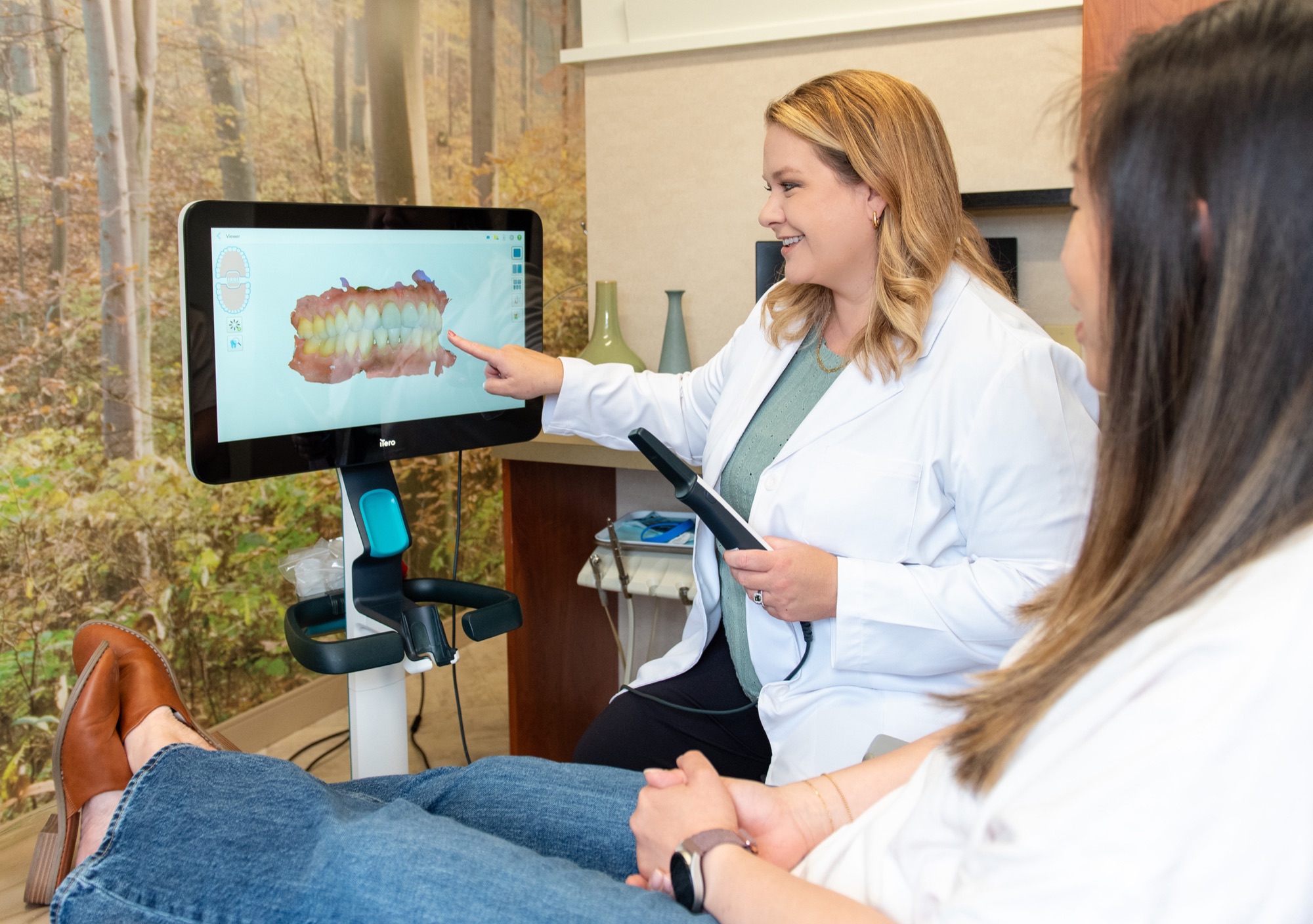
A periodontal examination is part of every comprehensive exam here. Gum disease is the condition most likely to be quietly underway in a mouth that feels fine, so it gets measured rather than eyeballed at your regular checkup and cleaning.
How we treat periodontal disease
Treatment is staged to what is actually happening in your mouth. Nobody needs the whole list, and which parts apply is decided from measurements rather than impressions.
Scaling and root planing
A deep cleaning below the gumline, where a routine cleaning does not reach. Scaling removes hardened deposits from the roots; planing smooths them so the gum can reattach. Usually done in sections, with the area numbed.
Laser Bacterial Reduction with the Picasso Laser
We use the Picasso Laser by AMD Lasers. It is a painless treatment that targets and significantly reduces bacteria beneath the gums, and we recommend it particularly for food traps, bad breath, bleeding gums, or gingivitis. It carries an additional fee and is not part of a standard cleaning, so it is something we discuss and you choose.
Antibiotic therapy
Localized antibiotics placed directly into a pocket that has not responded as well as the sites around it. A targeted addition to deep cleaning, not a substitute for it.
Bone and soft tissue grafting
For advanced disease, where supporting structure has already been lost. A regenerative approach that belongs to the later end of the range rather than a first appointment.
Ongoing maintenance
Regular follow-up visits, often on a shorter interval than a six-month recall. This determines the long-term outcome, and it is the part most easily skipped once the gums stop bleeding.
Periodontist referrals
Some cases are best managed by a specialist, and Dr. Lokitis coordinates with a periodontist rather than treating around the problem. Your general care continues here in parallel.

How to keep your gums from bleeding
Most of what protects gum tissue is unglamorous and happens at home. These are the measures we actually recommend.
Gums that bleed a little more when you first start flossing usually settle within a week or two, which is different from ongoing bleeding at a site that never improves. And if you clench at night, the extra load on already-compromised support does not help, which is why teeth grinding comes up too.
Your partner in gum health
Gum disease is managed over years, so the treatment is a relationship rather than an appointment. Dr. Julia Lokitis earned her DDS from the University of Maryland, Baltimore with special honors in prosthodontics, completed a one-year general practice residency at York Hospital in Pennsylvania, and has spent over 15 years in general practice.
Nobody here will lecture you about your dental history. Many people arrive after years away, embarrassed about what a hygienist will find, and that is the moment when feeling judged makes someone leave and not come back. You will be told what your measurements are, what they mean, and what anything costs before it starts. The comfort menu, including nitrous oxide for an additional fee, exists so a deep cleaning is something you can get through.

Where gum health touches the rest of your treatment
New crowns and veneers are shaped to a gumline, so it matters whether that gumline is stable. Implants depend on bone, which is the thing periodontal disease removes. Where support has been lost past the point of saving a tooth, extraction becomes part of the plan, and planning the replacement at the same time is how you avoid losing more bone while you decide.
The most useful appointment remains the unremarkable one. Twice-yearly cleanings and exams are where pockets get measured and gingivitis gets caught while it is still reversible. If it has been a while, call (703) 893-1603. We are open Monday 8:30 to 5:00, Tuesday 9:30 to 6:00, Wednesday 8:30 to 5:00, and Thursday 7:30 to 2:00, and closed Friday through Sunday. If a gum is swollen and painful, see emergency dentistry; over a weekend, swelling that is spreading or affecting your breathing belongs in a hospital emergency room.
Frequently Asked Questions
Why do my gums bleed when I brush? expand_more
Infection, injury, or inflammation is the usual cause, and the most common is inflammation from plaque sitting along the gumline. Healthy gum tissue does not bleed when brushed, so bleeding is a signal rather than a normal part of cleaning your teeth. Smoking, diabetes, some medications, pregnancy, and brushing too hard can all contribute.
Can gum disease be reversed? expand_more
Early-stage gingivitis can often be reversed with a professional cleaning and improved home care, because nothing structural has been lost yet. Once attachment and bone have gone, that loss is not reversed by cleaning, and the goal becomes controlling the infection and holding the ground you still have.
What is scaling and root planing, and does it hurt? expand_more
It is a deep cleaning that works below the gumline. Scaling removes hardened deposits from the root surfaces and planing smooths them so the gum can reattach. The area is numbed, and it is usually done in sections over more than one visit. Most people find the treatment comfortable and the day afterwards a little tender.
What is Laser Bacterial Reduction with the Picasso Laser? expand_more
We use the Picasso Laser by AMD Lasers. It is a painless treatment that targets and significantly reduces bacteria beneath the gums, and we recommend it particularly for food traps, bad breath, bleeding gums, and gingivitis. It carries an additional fee and is not included in a standard cleaning, so it is something we will explain and offer rather than add without a conversation.
How often will I need periodontal maintenance visits? expand_more
More often than twice a year in most cases, at least while things are being brought under control. The interval is set from your measurements and how the tissue is responding, and it can be lengthened again once the picture is stable. Maintenance decides the long-term outcome, and it is the easiest part to let slide.
Can gum disease make me lose teeth? expand_more
Yes. Advanced periodontal disease destroys the bone and attachment that hold teeth in place, and a tooth with too little support left eventually becomes loose and has to be removed. That is why a loose tooth or a bite that has shifted is worth an appointment rather than a wait.
Will I be referred to a periodontist? expand_more
Sometimes, and it is part of how this is meant to work. A great deal of periodontal care is managed here, including deep cleaning, laser bacterial reduction, localized antibiotics, and maintenance. Where the disease is advanced or surgery is the right answer, Dr. Lokitis coordinates with a periodontist while your general care continues here.
Bleeding gums are worth an appointment.
A periodontal examination measures what is actually happening rather than guessing at it, and gingivitis caught early is still fully reversible. Contact our Vienna office, minutes from Tysons Corner.