Teeth Whitening
Professional whitening lifts the shade of natural enamel with a controlled peroxide gel, under supervision, with your gums protected. It is the most requested cosmetic procedure in dentistry, and at our Vienna office — minutes from Tysons Corner — the in-office version is done in a single visit with no downtime afterwards.
Why the shade changes at all
Teeth darken for two quite different reasons, and whitening treats them very differently. Surface staining sits in the outer enamel and comes from the things that pass over it every day — coffee, tea, red wine, dark berries, tobacco. Deeper discoloration lives in the dentine underneath, and arrives with age, after trauma to a tooth, or from certain medications taken in childhood. A peroxide gel works on the first far more predictably than the second.
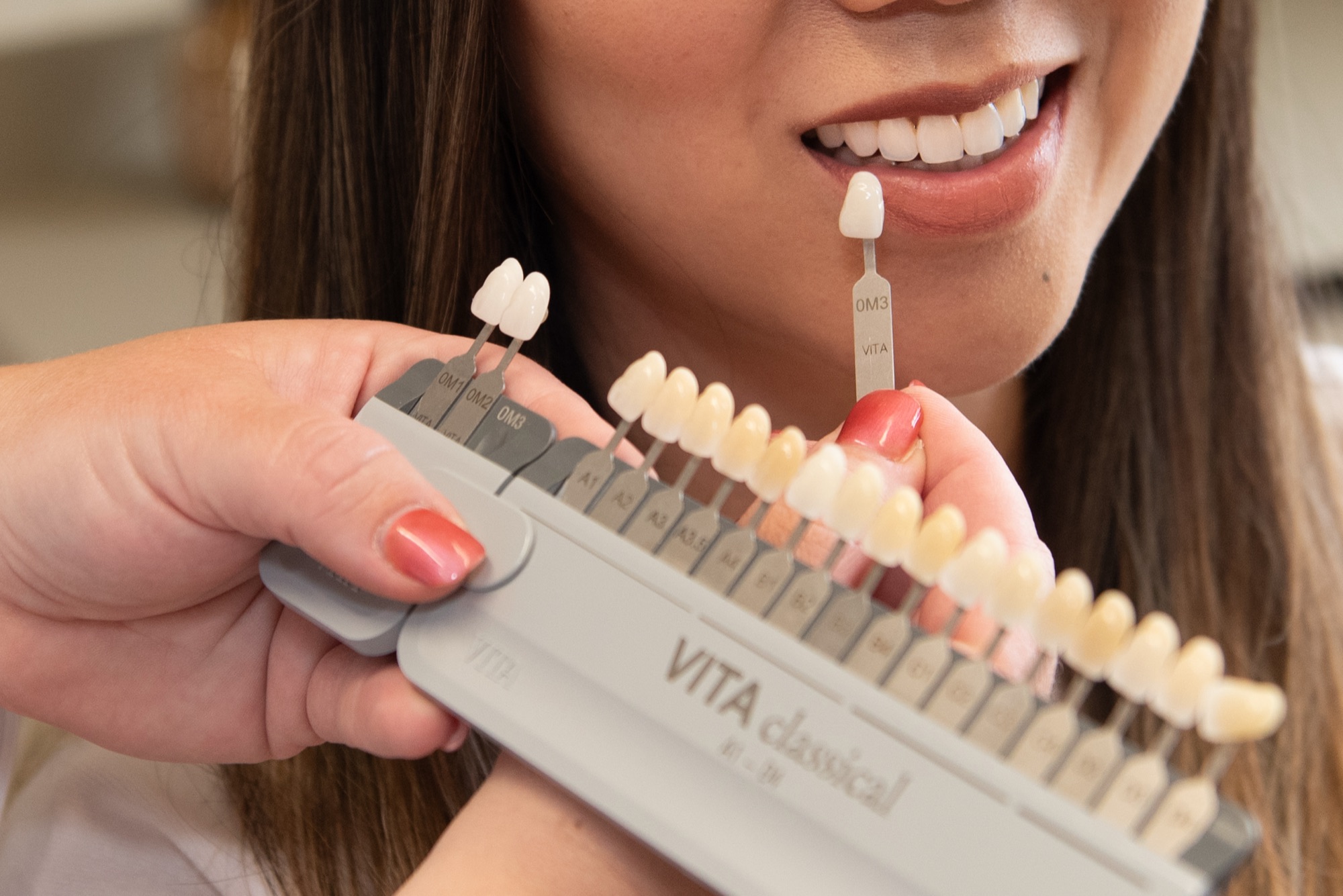
Which is why the first thing that happens at a whitening appointment is that somebody looks. A shade guide is held against your teeth so that you and Dr. Lokitis are describing the same color rather than two different ideas of white, and so the starting point is recorded rather than remembered. It takes a couple of minutes and it is the difference between a realistic expectation and a disappointed one.
Yellowish teeth generally respond better than brownish or grayish ones. That is an honest starting assumption rather than a guarantee, and if your discoloration looks like the kind that gel will not shift, we would rather say so at that point than after you have paid for a course of it. Sometimes the better answer for a single stubbornly dark tooth is bonding or a veneer instead.
In-office whitening, step by step
There are four parts to the appointment, and none of them is a surprise.
1. Comfort assessment and shade discussion
We ask about sensitivity, look at what is causing the discoloration, and agree the shade you are aiming for against a shade guide. This is also where we say what we think is achievable.
2. Tooth cleaning with gum protection
The teeth are cleaned so the gel is working on enamel rather than on film, and your gums and lips are isolated and protected before anything is applied.
3. Gel application with light activation
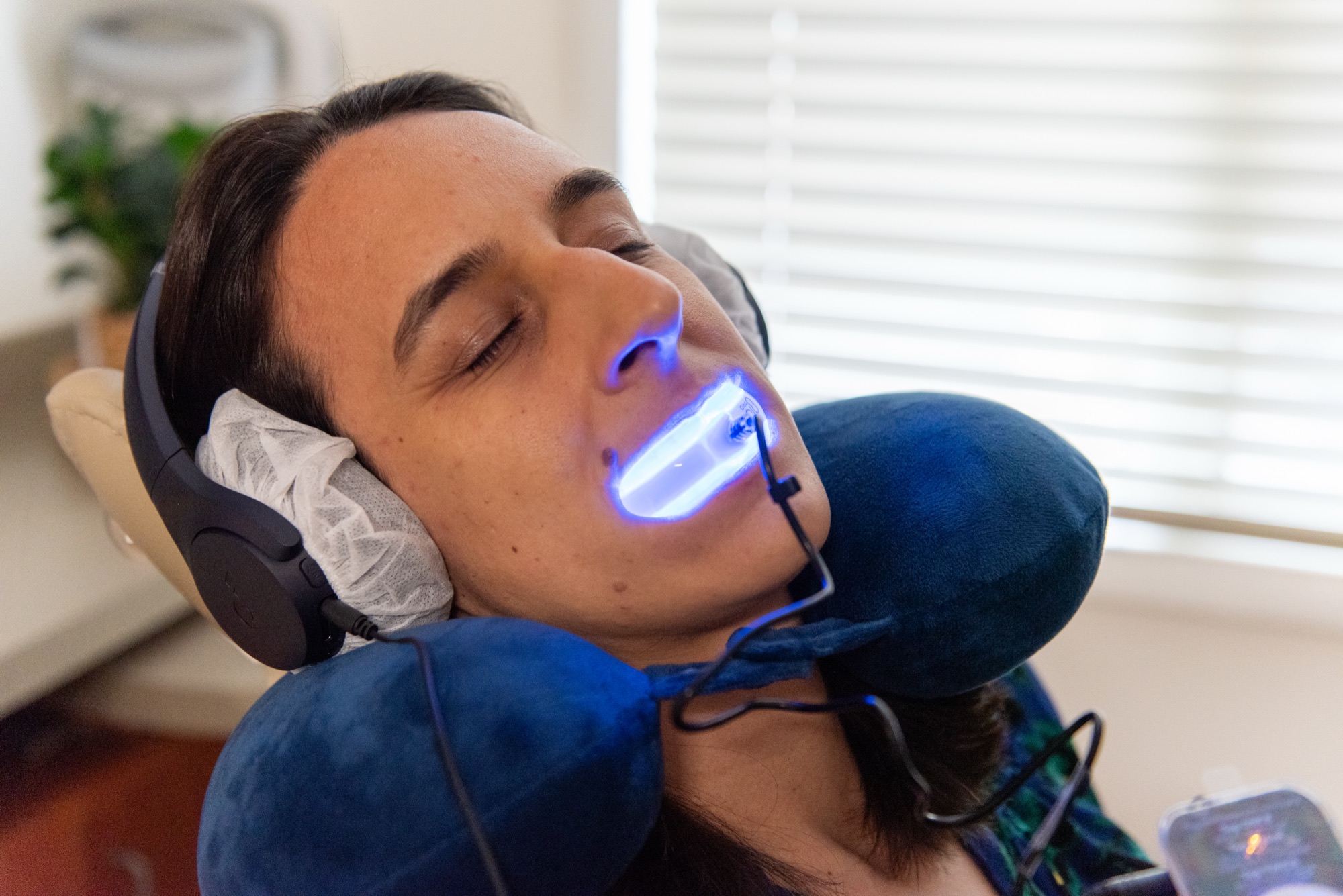
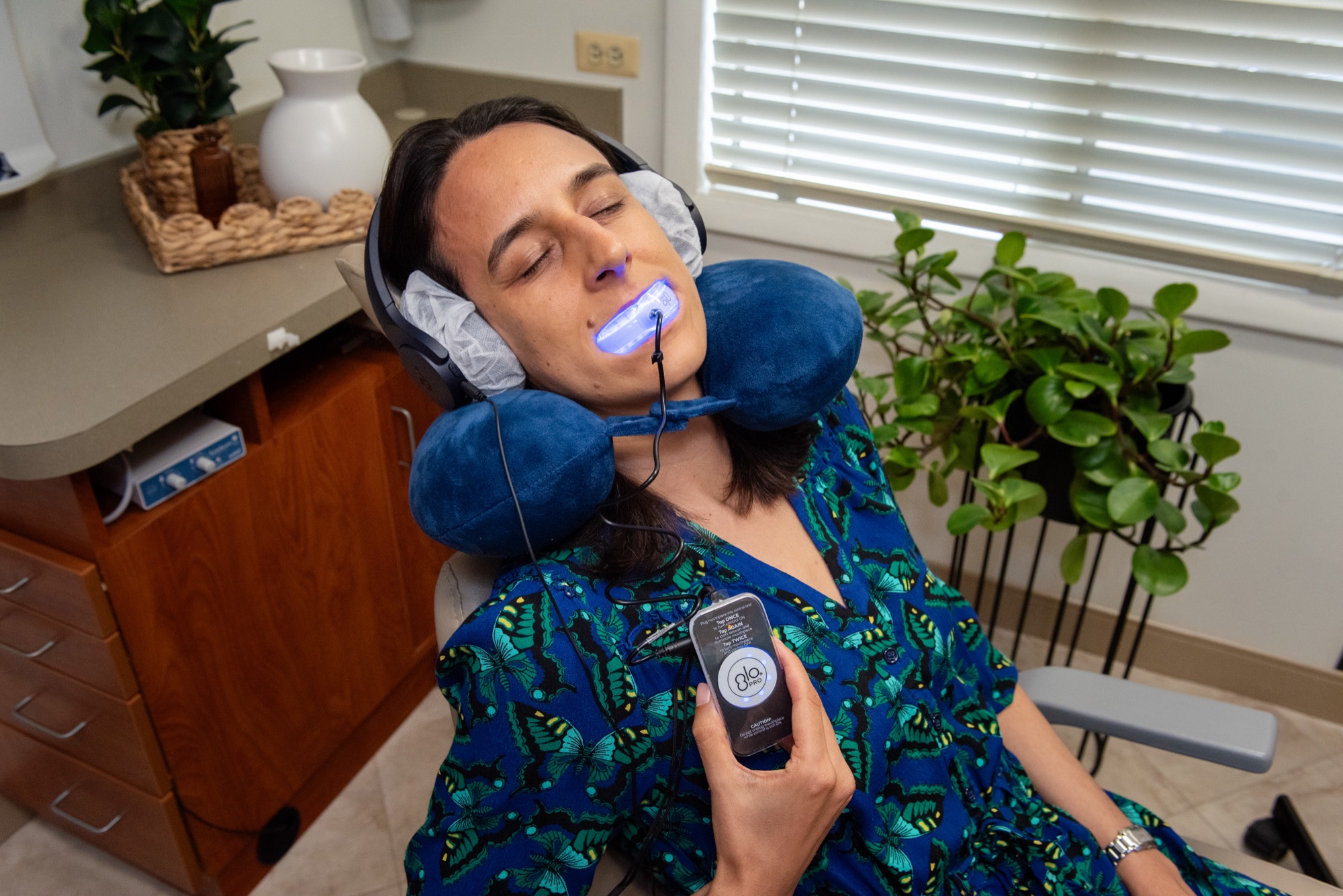
The whitening gel goes on and is activated with a blue light for around 40 minutes. You are reclined for this part and there is nothing for you to do.
4. Gel removal and immediate results
The gel comes off, we look at the shade against the guide again, and you see where you have landed before you leave. There is no downtime and you can go straight back to your day.
Forty minutes in a chair is the part people ask about most, so it is worth saying what it is like. Our comfort menu is a real printed card in the office, and the things on it that most whitening patients reach for are a neck pillow, a soft blanket and the noise-cancelling headphones with music. Nobody expects you to lie there stoically. Tell us what would make the time easier and we will get it.
Take-home trays
The other route is a custom take-home kit. Mouthpieces are made from impressions of your own teeth, so the gel stays where it belongs instead of pooling on your gums, and you use them over roughly two weeks, a short session at a time.
It is a slower, gentler curve, which suits people who would rather approach the change gradually, and people whose sensitivity means a long single session is not the kindest option. The trays are also yours afterwards, which is the quiet advantage: touch-ups later cost you gel rather than another appointment.
Many people do both — a course in the office to get the shift, then trays to hold it. Dr. Lokitis will tell you which she thinks fits your teeth and your calendar, and there is no pressure to take the more expensive route.
What whitening will not change
This is the section most whitening pages leave out, and it is the one worth reading.
The restoration point has a practical consequence. If you have white fillings or a crown on a front tooth, whitening the natural teeth around them can make the restoration look darker by comparison, because it stayed put while everything else moved. That is not a reason to avoid whitening; it is a reason to plan the order. Whiten first, let the shade settle, then have new fillings or a new crown matched to where you have ended up.
And if what actually bothers you is a chipped edge, an uneven length or a gap rather than the color, whitening is the wrong tool. Contouring reshapes, bonding rebuilds, and veneers resurface. It is common for a consultation to end with a shorter, cheaper answer than the one somebody walked in asking for.
Sensitivity, and working around it
Temporary sensitivity and mild gum irritation are the two side effects that come up, and in most cases both have gone within a day or two. A desensitizing toothpaste in the days before and after helps a lot of people, and your gums are isolated during the in-office treatment specifically to keep gel off them.
What we would ask is that you tell us rather than press on quietly. Sensitivity is not the price of a whiter shade. There are several dials to turn — a shorter session, a lower-concentration gel at home, more days between sessions — and choosing between them is a two-minute conversation, not a setback.
If your teeth are already sensitive before any whitening, that is worth mentioning at the consultation, because it sometimes points at something else. Exposed root surfaces, a cracked filling and worn enamel from grinding all cause sensitivity, and none of them is fixed by bleaching. Dr. Lokitis would rather find that first.
Making the result last
No whitening is permanent, because the causes are not. Coffee, tea, red wine, dark berries, soy sauce and tobacco all put color back over months, and few people are willing to give those up. Rinsing with plain water afterwards, and not letting a dark drink sit in your mouth all morning, does more than most people expect.
Regular cleanings matter here too, because a professional clean removes the surface film that dulls the result even when the underlying shade has not changed. And if you have take-home trays, an occasional short touch-up session is usually enough to hold the line rather than starting over.
Who does the work
Dr. Julia Lokitis earned her DDS from the University of Maryland, Baltimore with special honors in prosthodontics, and completed a one-year general practice residency at York Hospital in Pennsylvania with advanced training in cosmetic procedures, veneers and restorative work. She has spent over 15 years in general practice.
That prosthodontic grounding is more relevant to whitening than it sounds, because shade is a restorative problem as much as a cosmetic one. Anyone can apply a gel. Knowing where the shade needs to land so that a future crown or veneer can be matched to it, and in what order to do the two, is the part that saves you from having the work done twice.
We explain what is involved and what it costs before anything begins, and there is no upselling and no pressure to start. Our office is on Old Courthouse Road in Vienna, a few minutes from Tysons Corner and convenient to McLean, Dunn Loring, Merrifield, Oakton and Falls Church.
Frequently Asked Questions
How long does professional whitening take? expand_more
The in-office appointment is a single visit. Roughly 40 minutes of it is gel-and-light time, with the preparation and the shade discussion either side of that. You see the result before you leave and there is no downtime afterwards. Take-home trays work differently: those are used over about two weeks, a short session at a time.
Which teeth respond best to whitening? expand_more
Yellowish teeth generally respond better than brownish or grayish ones. That is the honest starting assumption rather than a rule without exceptions, and it is one of the reasons we agree a shade and look at what is causing the discoloration before anything is opened. Some discoloration sits inside the tooth rather than on it, and gel has much less effect on that.
Will whitening change the color of my fillings or crowns? expand_more
No. Whitening has no effect on tooth-colored composite fillings, and the same is true of crowns, bridges and veneers, which hold whatever shade they were made in. This matters for sequencing more than anything else: if you are planning new front-tooth work, whiten first so the new porcelain or composite can be matched to the lighter shade rather than the old one.
Does whitening hurt? expand_more
Most people describe it as uneventful. The two side effects worth knowing about are temporary tooth sensitivity and some gum irritation, and both usually settle within a day or two. Your gums are protected before the gel goes on. If you already know your teeth are sensitive, tell us at the start and we can adjust the protocol, shorten the session, or space treatment out instead.
Is in-office or take-home whitening better? expand_more
They suit different people rather than one being better. In-office is supervised, finished in a single visit, and useful if you have a date in mind. Take-home trays are custom-made from impressions of your own teeth, work more gradually, and stay with you afterwards for occasional touch-ups. Some people do a course in the office and keep trays for maintenance.
How long do the results last? expand_more
Nobody can give you a fixed figure, because it depends mostly on what goes past your teeth afterwards. Coffee, tea, red wine, dark berries and tobacco all put color back. Rinsing with water after them helps, as does keeping to your regular cleanings. Many people find an occasional touch-up with take-home trays keeps things where they want them.
Is teeth whitening covered by dental insurance? expand_more
Whitening is elective and cosmetic, so it is generally not something dental plans cover. We will tell you what treatment involves and what it costs before anything starts, and if you want us to check your benefits for any other work we discuss at the same visit, we are happy to do that.
Start with a shade and a conversation.
A whitening consultation is a look, a shade guide, and an honest answer about what gel will and will not shift on your teeth. Contact our Vienna office, minutes from Tysons Corner, and we will take it from there.