Porcelain Veneers
Veneers are custom-fitted porcelain shells bonded to the front surfaces of your teeth, made to address teeth that are crooked, misshapen, gapped, chipped, stained, cracked or worn. They need minimal enamel removal and typically last 10 to 15 years. Dr. Julia Lokitis plans and fits them at our Vienna office, minutes from Tysons Corner.
What a veneer actually is
A veneer is a thin shell of porcelain, made to fit one specific tooth, bonded to the front of it. That is the whole idea. It does not replace the tooth or wrap around it — it resurfaces the face of it, which is the part anybody sees when you talk.
Because it resurfaces rather than replaces, a veneer can change several things at once that would otherwise need separate treatments. The color of the shell is chosen, so a tooth that will not respond to whitening can still be lightened. The shape and length are built into the shell, so a chipped edge or a short tooth can be brought back into line with its neighbors. And because the porcelain has thickness, a slightly rotated or recessed tooth can be made to read as though it sits where the others do.
What a veneer is not is a shortcut past dental health. The tooth underneath has to be sound and the gums around it have to be healthy, because a shell is only as stable as what it is bonded to. If there is decay or active gum inflammation, that gets treated first. That is not caution for its own sake; it is the difference between a veneer that lasts and one that fails at the margin.
What veneers are good at
The list below is the honest scope. Most people arrive with one or two of these rather than all of them.
There are limits worth stating here rather than at the consultation. Veneers are not orthodontics: if teeth genuinely need moving, masking that with porcelain means preparing more enamel than anybody should, and clear aligners first is usually the better sequence. They are also not the right answer on a tooth that has lost a lot of structure, where a crown does the job properly.
And if you grind or clench at night, that has to be part of the conversation before anything is bonded. Porcelain is strong but it is not indestructible, and a nightly load it was never designed for is the fastest way to chip one. That does not rule veneers out; it usually means a night guard goes into the plan alongside them. It is worth reading teeth grinding if you already suspect you do it.
How your veneers are made
Veneers take two main appointments with laboratory time in between. This is the shape of it.
1. Consultation and planning
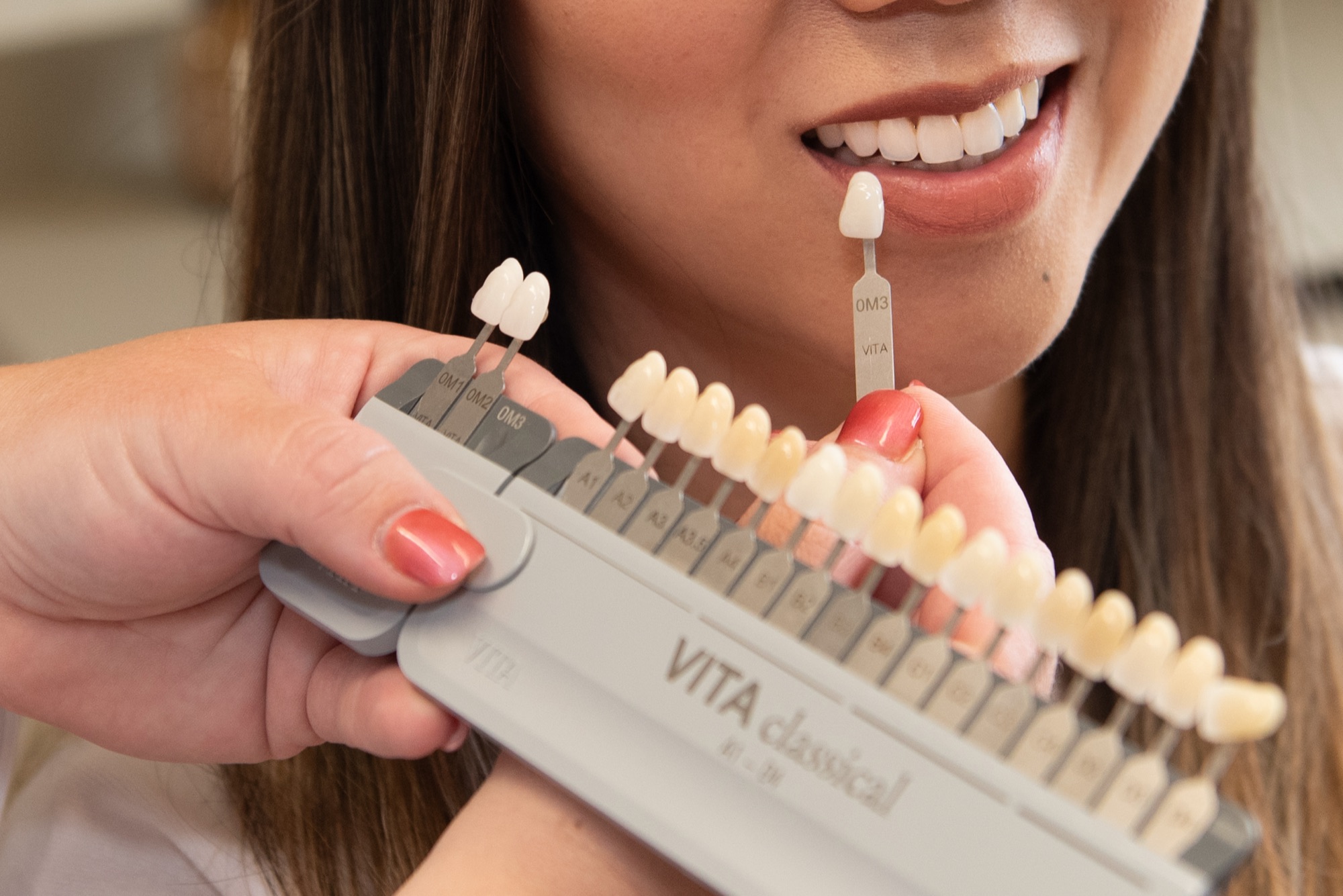
An exam first, to confirm the teeth and gums can carry veneers, then a conversation about what you want changed. Shade, shape and how many teeth are all decided here, with a shade guide against your own teeth rather than from a brochure.
2. Light enamel preparation
A small amount of enamel is removed from the front of each tooth so the veneer sits flush rather than proud. This is minimal by design and is done under local anesthetic.
3. Impressions
Precise impressions of the prepared teeth go to the laboratory, along with the shade and shape notes, so the porcelain is made for your teeth rather than adjusted to fit them.
4. Temporary veneers
You leave with temporaries on, so you are not walking around with prepared teeth. They also give you a preview and a chance to say something feels long, or bulky, or not quite right.
5. Color and shape approval
Before anything is permanently bonded, the finished veneers are tried in and you approve the color and the shape. This is the point to speak up, and we would much rather you did.
6. Bonding
The tooth surface is cleaned and conditioned, bonding adhesive is applied, and each veneer is seated and cured into place.
7. Final buffing and bite check
The margins are smoothed and polished, and your bite is checked so the new surfaces meet the way the old ones did. Getting this right is why the prosthodontic side of the work matters.
The laboratory behind the porcelain
A veneer is only as good as the hands that make it, and those hands are not in our building. Oral Prosthetics Lab is the dental laboratory this practice works with, and the reason we name it rather than keep it vague is that the choice of lab is one of the real variables in how custom porcelain turns out.
The same relationship shapes our crown work, where the material choice is made case by case: e.max lithium disilicate for its aesthetics and translucency on front teeth, and BruxZir Zirconia where durability matters more, such as back teeth and patients who grind. It is worth knowing that this kind of thinking exists, because it is the same thinking applied to a veneer.
In practice this is why the approval appointment is not a formality. The porcelain arrives made to a specification, and if the specification was wrong, we would rather find out with the veneers held in place than after they are bonded.
Living with veneers
Veneers typically last 10 to 15 years with proper care, and the care is mostly the care you already take. Brush and floss normally. Keep your cleanings and exams, because the margin where porcelain meets tooth is exactly the kind of place a hygienist is trained to watch.
Porcelain is strong and stain-resistant, which is a real advantage over composite: coffee and red wine do far less to it. What can change is the natural tooth structure around and behind it, and the natural teeth next to it, which is the practical argument for settling the shade of everything else before the veneers are made rather than after.
The habits that end veneers early are mechanical rather than chemical. Biting fingernails, opening things with your teeth, chewing ice, and grinding at night are the ones we mention. If a veneer does chip or come loose, call us — it is replaceable individually, and it is a much smaller problem attended to early.
Veneers, bonding, or contouring
Three cosmetic treatments overlap here, and the cheapest one that solves your problem is the right one.
Bonding
Composite resin shaped directly onto the tooth in one visit, with no laboratory stage. Generally lasts 7 to 10 years and is a cost-effective alternative to veneers for a small chip, a narrow gap or a single discolored spot.
Contouring
Removing a small amount of enamel to reshape a tooth. Only minor changes are possible, but if what bothers you is one edge slightly longer than its neighbor, this may be the whole answer and it is the least invasive of the three.
Veneers
Custom porcelain made in a laboratory, bonded to the front of the tooth. More involved than the other two, more durable and more stain-resistant than composite, and the option that can change color, shape and apparent position together.
Who plans and fits them
Dr. Julia Lokitis earned her DDS from the University of Maryland, Baltimore with special honors in prosthodontics — the discipline concerned with how teeth are restored and how a bite fits together. She completed a one-year general practice residency at York Hospital in Pennsylvania with advanced training in cosmetic procedures, veneers and restorative work, and has spent over 15 years in general practice.
For veneers, that background is the point rather than a credential to list. Front teeth are not decoration; they guide your bite. Changing their length and shape changes how your jaw closes and where the load lands, and a set of veneers planned only on how they look in a mirror is a set that can chip, or leave your jaw uncomfortable. Her practice looks at how your teeth meet before it looks at shade.
We explain procedures thoroughly and build a plan around what you actually want, with no upselling and no pressure to start. Our office is on Old Courthouse Road in Vienna, a few minutes from Tysons Corner and convenient to McLean, Dunn Loring, Merrifield, Oakton, Great Falls and Falls Church.
Frequently Asked Questions
How long do porcelain veneers last? expand_more
Veneers typically last 10 to 15 years with proper care. What ends a veneer is usually not the porcelain wearing out but the tooth or the bond underneath it, which is why your regular cleanings and exams matter as much after veneers as before. When one does need replacing, it is replaced individually rather than the whole set at once.
Do veneers require removing much enamel? expand_more
Veneers involve minimal enamel removal, which is one of their genuine advantages over a crown. A crown covers the whole tooth and needs the tooth reduced on every surface; a veneer covers the front, so only a light preparation of that surface is needed. It is not nothing, though, and it is not reversible, which is why we would rather talk you through the alternatives first.
Are veneers painful? expand_more
The preparation appointment is done with local anesthetic and most people report minimal discomfort. You may notice some sensitivity between the preparation visit and the fitting visit, while temporary veneers are in place, and that settles once the permanent ones are bonded. Tell us if a temporary feels rough or catches, because that is a quick fix rather than something to endure.
Can veneers stain? expand_more
Porcelain is strong and stain-resistant, and it holds its color far better than natural enamel or composite does. What can discolor over time is the margin where the veneer meets the tooth, and the natural teeth alongside it. That is the main reason we settle the shade of your natural teeth before the veneers are made rather than after.
How many teeth need veneers? expand_more
As few as one. A single chipped or discolored front tooth can be veneered on its own, though matching one veneer into an existing smile is more demanding than making several to a shared plan. Many people have a small number across the front teeth that show when they talk and smile. Dr. Lokitis will tell you honestly whether one will blend or whether the result would look more even across two or four.
What is the difference between a veneer and a crown? expand_more
A veneer resurfaces the front of a tooth. A crown covers the whole of it. A veneer is the more conservative option and is generally less costly than a crown, but it relies on the tooth underneath being sound. If a tooth is heavily decayed, has had a root canal, or is cracked, a crown is the right answer and a veneer is not, because there is not enough healthy structure for a thin shell to be bonded to.
Does dental insurance cover veneers? expand_more
Veneers placed for appearance are usually treated as elective, so most dental plans do not cover them. Where a tooth is being restored because it is broken or worn rather than because of how it looks, the picture can be different. We are happy to check your benefits before you commit to anything, and you will know what treatment costs before it begins.
See what veneers would and would not change.
A consultation is an exam, a shade guide against your own teeth, and a straight answer about whether porcelain is the right tool or whether something smaller would do. Contact our Vienna office, minutes from Tysons Corner.